

Run every scenario in minutes
As a mine planner, you already know which assumptions move the plan. Cognomine gives you the compute to test all of them. Keep more of the operating detail in the model, get a practical schedule back in minutes, and deliver a strategic or life-of-mine plan built on a wider set of tested scenarios.
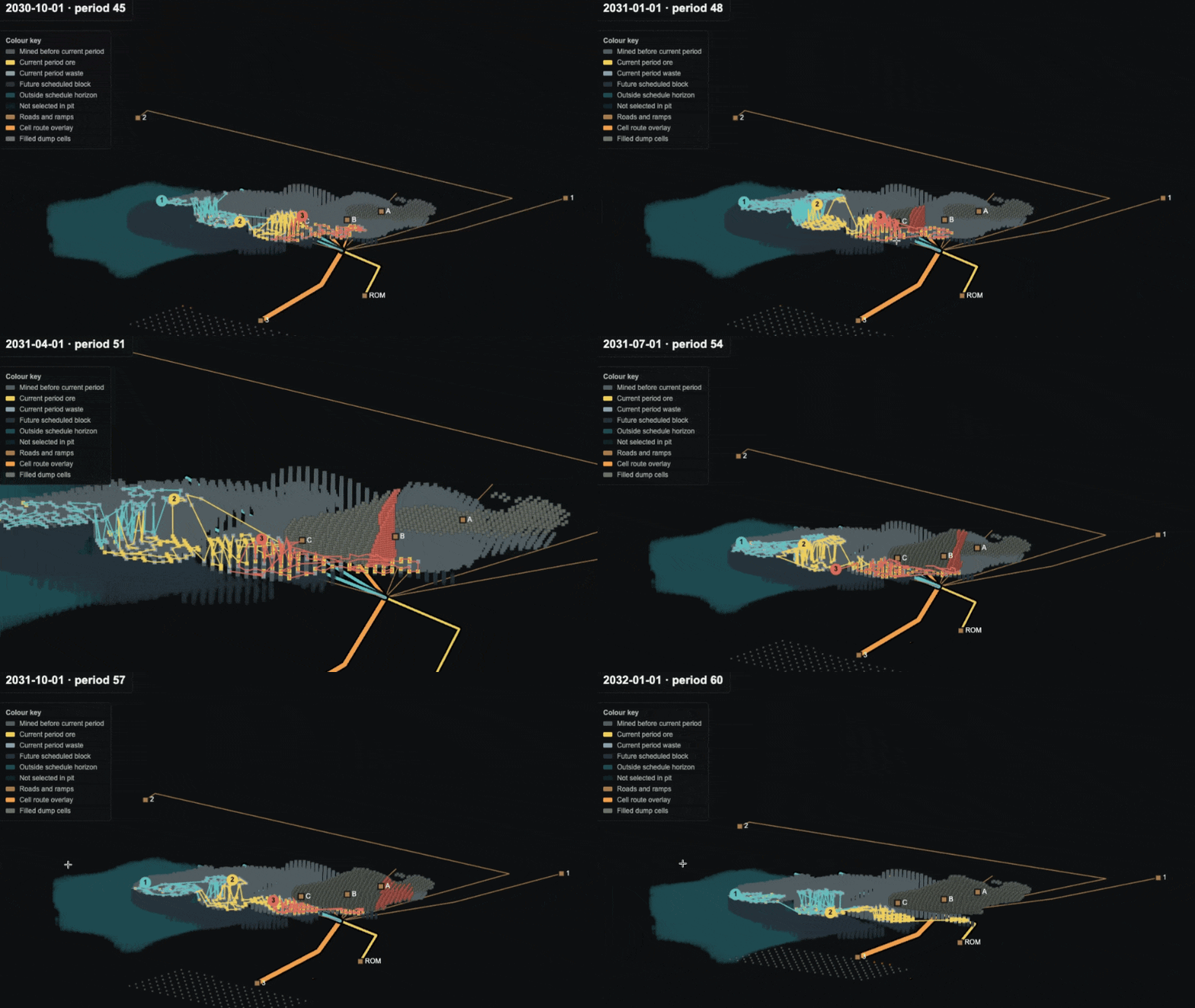
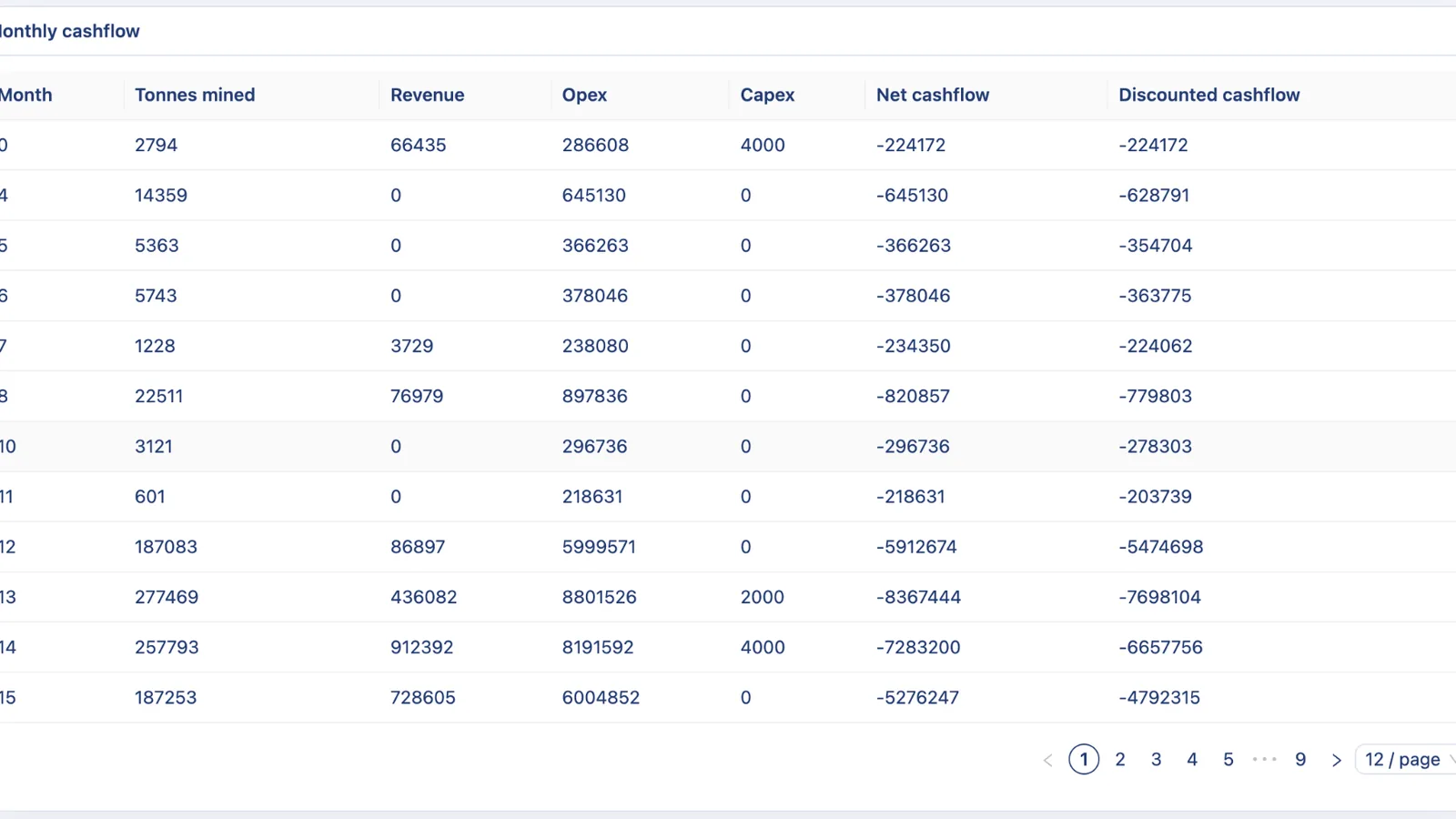
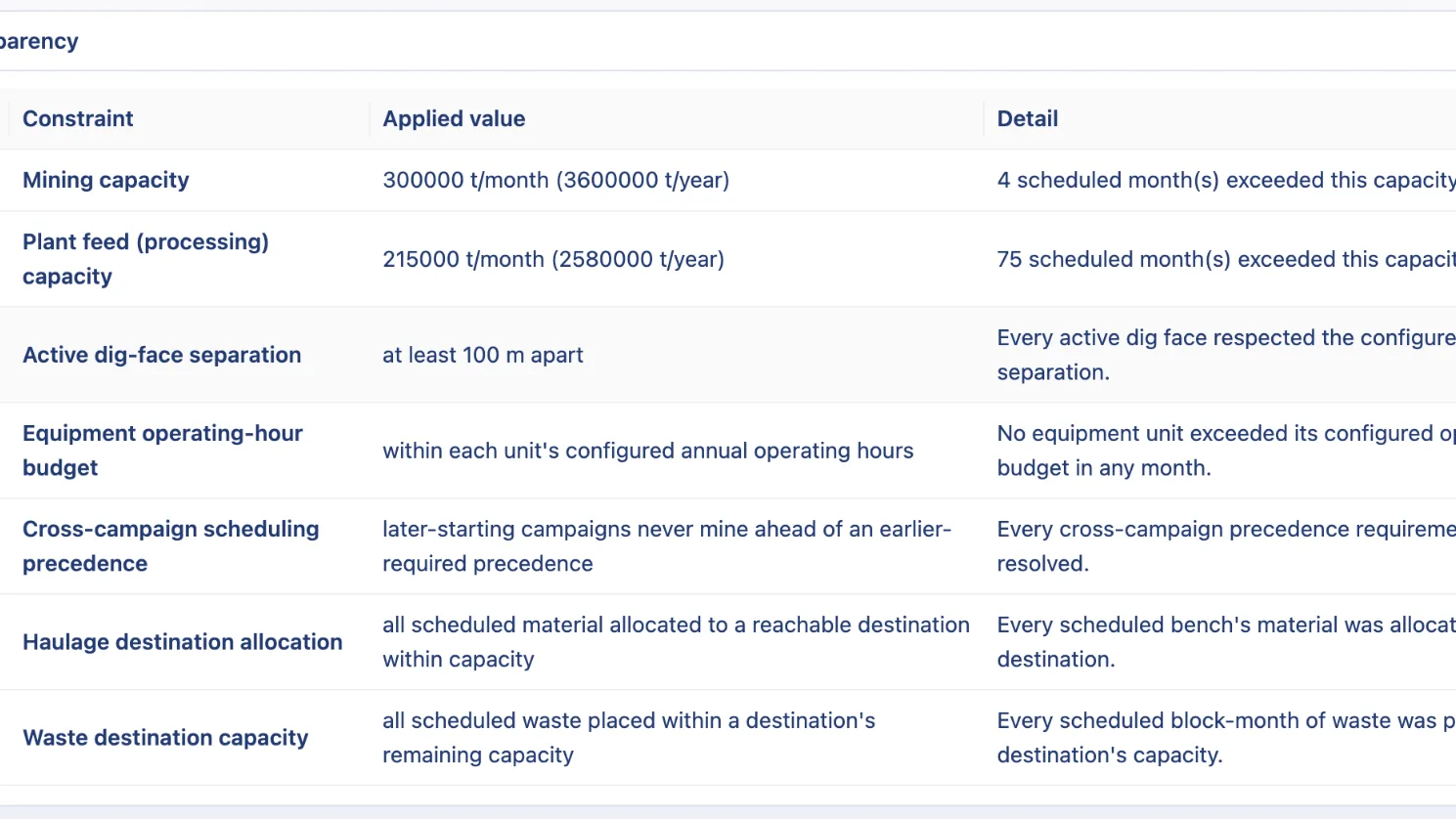
Three solves in a single pass
Pit selection, block schedule optimisation and haulage optimisation are normally three separate steps, often in different tools. Getting the data ready for each one, and keeping the three aligned as assumptions move, takes a good share of the time a study runs on.
Cognomine solves all three in a single pass. Ultimate pit selection decides what is economic to extract, the block schedule decides what gets mined when, and haulage decides how the material moves and what fleet that needs. Because they resolve together rather than one after another, there is one set of inputs to prepare and one result to defend.
A compute limit, not a planning limit
Strategic scheduling has always been bounded by what a solver can hold in one pass. To get a long-horizon answer out in reasonable time, some of the operating detail has to be set aside. Every strategic planner knows this trade-off and manages it well, which is why the plans that come out the other side still work. The cost is that one end-to-end pass takes hours or days, so a study that would benefit from testing dozens of scenarios usually ships with two or three. Cognomine is built to lift that ceiling.
Keep the detail, get the answer in minutes
Cognomine encodes more of the operating detail up front and solves it in the cloud. We have benchmarked it on realistic strategic scenarios and it returned schedules in minutes: the same question you have always asked, with more of the constraints left in.
Because a run costs nothing beyond the credit already on your account, you can test every scenario your study calls for: a different commodity price deck, a delayed capital project, a changed cut-off grade, then compare them side by side before you commit to the plan you want to defend. Commodity prices move through cycles, so being able to re-run against several price decks in an afternoon is worth more than getting one deck exactly right.
The detail that stays in the model includes bench and phase sequencing, dig precedence, processing capacity, grade targets, stockpile strategy, and the capital and operating trade-offs behind them. Keeping them in one solve gives you a schedule that arrives closer to publishable. The full list is on the how it works page.
What we have measured
Across the strategic scenarios we have benchmarked, Cognomine returned workable schedules in 10 to 20 minutes. On the same problems, open-source solvers had not converged when we stopped them at 12 and 24 hours.
On one ten-year benchmark case, built from the same orebody and the same constraints as the open-source baseline, the Cognomine plan carried US$98M more NPV, about 6% higher, and needed 30% less equipment capital.
We benchmark against open-source solvers, so these figures show the gap against freely available tools, not against every commercial package. And the value is not only speed. Because the model keeps more of the real operating detail, the schedule arrives closer to publishable, and you can run the scenarios the decision needs rather than the two the clock allowed.
Block model and constraints in, schedule out
Bring a block model in a standard format, along with the constraints that shape the plan.
Set the parameters and run in the cloud. Results come back in minutes.
Take the schedule and its supporting outputs into your existing workflow.
Hosted in the cloud, so there is nothing to install. On-site deployment is available for teams that need it. Want to see it running before you commit? Book a call and we will walk you through the demo.
See how it works →See it on your scenario
If you have a strategic or life-of-mine study running, or one you are scoping, we would like to hear about it.